 AssetStack
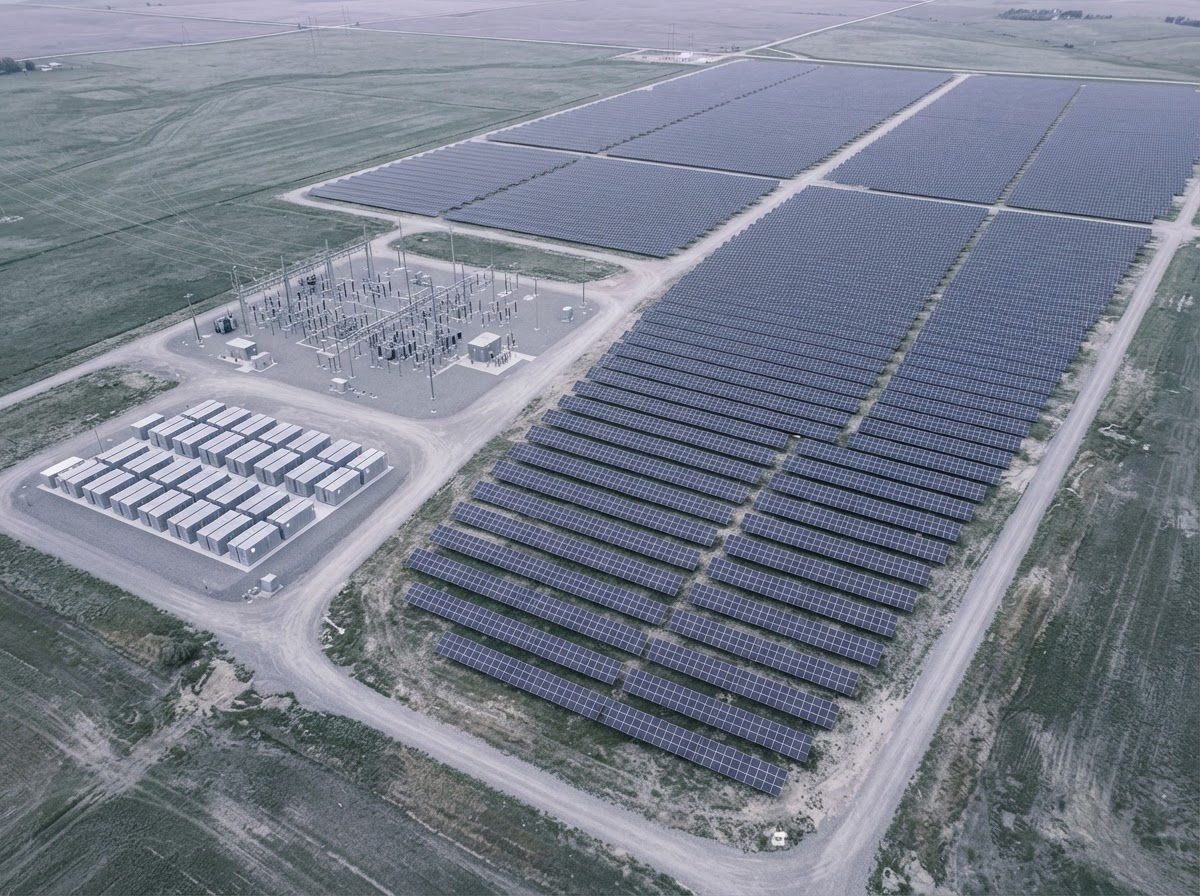
The operating system for Solar, Grid-Forming BESS & H2
Asset condition, maintenance and project delivery assurance for solar, battery storage and hybrid portfolios, with evidence-led grid compliance reviews.
Preview condition readings, budgets and intervention outcomes are illustrative, not verified operating results.
Utility Solar
Trackers, strings, combiner boxes and central or string inverters
Battery Storage
Racks, modules, cooling, BMS and power conversion systems
Hybrid Facilities
AC- and DC-coupled solar and storage with shared connections
Capital & Renewal
Separate estimates, commitments and verified outcomes
Dispatchable Firm Green Energy
AssetStack unifies utility-scale solar farms, grid-scale battery systems, hybrid facilities and their grid connection assets in one register.
| Facility | Typical scale | Type | Configuration | Description |
|---|---|---|---|---|
| Utility-scale solar farm | 50 to 500+ MWp | Solar PV | Single-axis trackers | Inverter, tracker and string-level condition monitoring with inspection findings linked to corrective work. |
| Grid-scale battery | 50 to 1,000+ MWh | BESS | Containerised racks | State-of-health, thermal balance, cooling and BMS calibration tracking against warranty curves. |
| Hybrid solar + storage | Combined sites | AC / DC-coupled | Shared connection | Separate facility identities at one site, with capacity, commercial roles and maintenance recorded independently. |
| Grid connection assets | HV substations | Transformers & switchgear | Protection systems | Transformer DGA, protection testing and network obligations with responsible owners and supporting evidence. |
Operating gigawatt fleets while assuring hybrid project delivery
Renewable developers and asset managers run solar, storage and hybrid projects across multiple regions. The platform distinguishes operating facilities from development and construction packages, and development or asset-management responsibilities from ownership.
- Main step-up transformers: online DGA monitoring to prevent connection trips
- Battery systems: cell temperature balancing, cooling health and state-of-health tracking
- Inverters and trackers: preventing thermal derating during extreme heat
- Generator performance standards: commissioning hold-point evidence, model validation and network obligations
- Hybrid construction programs: governing stage-gate EPC delivery and funding milestones
Everything in one place
Purpose-built for solar PV, grid-forming battery energy storage, green hydrogen, and major hybrid EPC delivery programs.
Evidence-Based Failure Diagnostics
Outlier-resistant trend analysis on each sensor channel, adjusted for load, irradiance, SOC and ambient conditions. A forecast is shown only when it beats a persistence baseline on held-out recent data; otherwise the engine withholds it rather than inventing a number.
Fleet Peer Comparison
Each PV and BESS asset is compared against like-for-like peers using outlier-resistant statistics, surfacing an underperforming inverter, string or battery before it breaches a configured limit.
Reviewed Interventions & Outcome Learning
Ranked engineering reviews with stated hypothesis, alternative causes, confirmation tests and expected net benefit, dispatched as inspection work orders. Field-verified outcomes build the labelled history needed for calibrated failure models.
Drone Thermography & Digital Twin
Review uploaded solar array, battery compound and substation inspection imagery. Link findings to equipment and maintenance actions; specialist thermography interpretation requires engineering verification.
10-Year Augmentation & Repowering
Compare battery augmentation, inverter renewal and solar repowering scenarios using recorded asset condition, useful-life assumptions and capital estimates.
Grid Code & System Strength
Register generator performance standards, commissioning hold points, protection tests and network obligations, with responsible owners and supporting evidence for independent review.
Verified Savings Ledger
Quantify every avoided forced outage and preserved dispatch interval with auditable engineering evidence for lenders and investment partners.
Hybrid EPC Assurance
Stage-gate governance, SLA tracking and executive risk escalation for solar, storage and hybrid construction programs.
Find failures before they cost generation
AssetStack turns raw telemetry into reviewed, evidence-backed maintenance decisions. Every forecast states what it is based on, how confident it is, and what test would confirm it.
Detect
Outlier-resistant trends on every sensor channel, with data-quality checks for gaps, flatlines and stale readings.
Adjust
Readings normalised for load, irradiance, ambient temperature and state of charge, so weather is not mistaken for wear.
Compare
Each inverter, string and battery benchmarked against like-for-like peers to isolate genuine underperformance.
Forecast
Time-to-threshold estimates with uncertainty ranges, shown only when they beat a persistence baseline on held-out data.
Act
Ranked interventions with hypothesis, confirmation test and expected net benefit, dispatched as inspection work orders.
Learn
Field-verified outcomes recorded against each prediction, building the labelled history for calibrated failure models.
Failure signals by asset class
Solar PV | Inverter IGBT and heatsink temperature drift, string current mismatch, tracker motor current, combiner box hot spots. |
Battery storage | State-of-health fade, cell voltage spread, internal resistance growth, cooling loop performance, BMS calibration drift. |
Grid connection | Transformer dissolved-gas trends, winding temperature, tap changer operations, protection relay health. |
Honest forecasts, not invented numbers
- Forecasts withheld when the data cannot support them
- Uncertainty ranges on every time-to-threshold estimate
- Alternative causes listed alongside each hypothesis
- Predictions scored against field-verified outcomes
- No failure probability claimed until enough confirmed outcomes exist
Moving from reactive to condition-based maintenance reduces forced outages, protects warranty positions and focuses crews on the assets that need them.
Your whole portfolio, live and in 3D
The AssetStack digital twin connects the physical site to its data. Every panel, rack, inverter and transformer sits in its real location, overlaid with live condition, sensor history and maintenance records, so engineers can see, test and act without travelling to site.
Spatial Twin
Navigate solar blocks, battery compounds and substations in 3D, built from LiDAR, photogrammetry or Matterport scans.
Live Condition Overlay
Health scores, sensor readings and open work orders mapped onto each asset, so problem areas are visible at a glance.
BESS Rack Thermal Twin
Rack, module and cell temperature and voltage shown in place, highlighting hot spots and imbalance across the container.
Self-Calibrating Model
The battery model updates itself against capacity tests and BMS data, so its predictions track the real system over time.
What-If Simulation
Test dispatch strategies, cooling failures and augmentation plans against the twin before committing on site.
Change Detection
Compare inspection scans over time to see what degraded, what was repaired and what still needs attention.
Find, compare and act in seconds
Every asset across every site in one interactive view, built for fast triage.
Search and jump
Type an asset name, type, site or serial number and go straight to it in the twin.
Colour modes
Colour every asset by health, failure risk or open work orders to see where attention is needed.
Time slider
Look up to 180 days ahead to see projected health and risk, based on each asset's remaining-life estimate.
Connected assets
Select an asset to highlight the equipment it depends on and the equipment that depends on it.
Right-click actions
Raise a work order, show connected assets or open the full asset record from any tile.
See it, then fix it
- Pin anomalies to exact locations with photos, measurements and likely causes
- Raise a work order directly from any asset in the twin
- Plan crew access, isolation points and safe work zones remotely
- Generate inspection and anomaly reports straight from the model
- Give lenders, insurers and partners a shared view of asset condition
A twin you can stand behind
The twin is only as good as the data behind it. Each overlay shows its source and when it was last updated, and simulated results are clearly separated from measured ones.
Fewer site visits, faster fault finding and a single source of truth for operations, engineering and finance.
Standardised Asset Taxonomy
AssetStack organises an entire fleet into a clean, traversable hierarchy. Drill down from regional hubs to individual solar farms and BESS compounds, down to transformers, battery banks and inverter skids.
- ISO 55000 aligned classification
- Parent-child cost rollup
- Equipment-linked sensor records
Built for the complexity of gigawatt-scale hybrid portfolios
From DC-coupled grid-forming inverters to multi-hour storage: AssetStack provides a single assurance backbone from EPC stage-gates to market dispatch.
- DC-Coupled Inverter & BESS Telemetry
- Generator Performance Standard & Hold Point Assurance
- Aerial Thermography & Substation Digital Twins
What it means for your portfolio
Capability is only worth what it changes on the ground. Here's the operational impact.
Evidence-led solar and BESS interventions
Illustrative operating workflows, not claims of realised savings. Record baseline costs, intervention costs and independent verification before reporting an outcome.
Substation transformer condition reviewReview recorded dissolved-gas trends, assign an engineering owner and document isolation prerequisites before approving transformer maintenance. | DGA evidence | Illustrative workflow |
Grid-forming service assuranceLink grid-forming performance evidence, network obligations and independent review records without treating service capability as additional installed capacity. | Review required | Illustrative workflow |
Battery cooling interventionInvestigate coolant and cell-temperature anomalies against OEM limits before agreeing maintenance windows with market counterparties. | Thermal review | Illustrative workflow |
Solar inspection findingsAssociate inspection images and verified electrical findings with the affected solar assets, corrective work orders and post-repair checks. | Field evidence | Illustrative workflow |
Battery renewal assessmentCompare recorded degradation, warranty conditions and renewal assumptions before recommending module replacement or augmentation. | SoH evidence | Illustrative workflow |
Storm-season readinessReview tracker condition, stow-test evidence, site access and weather-related work restrictions before storm-season maintenance. | Stow readiness | Illustrative workflow |
Justify every dollar to lenders & the board
AssetStack models 10-year BESS augmentation, inverter refurbishment and solar repowering programs across Balanced, Must-Do and Premium funding strategies.
- BESS augmentation and cell degradation schedules
- Risk-adjusted capital prioritisation for sponsors, investors and lenders
- Condition-based inverter and transformer replacement triggers
- Scenario modelling for hybrid facility ramp-up
Import assets through a controlled workflow
Import existing Excel, CSV, or legacy-system exports through a structured mapping and validation workflow before adding them to the asset hierarchy.
- Drag-and-drop bulk CSV/Excel imports
- AI-assisted column mapping and data cleaning
- Validated hierarchy generation from flat files
Command your fleet with natural language
Don't click through endless menus. Just ask AssetMind. Our domain-specific AI agent understands solar PV, grid-forming BESS, and grid compliance workflows.
Built for Critical Infrastructure
Bank-grade security, offline field capabilities, and deep system integrations ensure AssetStack meets the rigorous standards of national utility providers.
Security Controls
Encryption at rest and in transit, role-based access control, and comprehensive audit logging for operational actions.
Offline Field Mode
Full offline capabilities for remote sites. Technicians can complete inspections and sync automatically when back online.
SCADA Integration
Import sensor readings through configured ingestion endpoints or CSV workflows. Connections to SCADA, historian and ERP systems require separate integration setup.
Regulatory Auditing
Track facility-specific market operator and network obligations, electrical safety requirements, environmental approvals and EPC evidence for regulatory and lender reviews.
See it live with a renewable operating context
The platform preview is pre-loaded with sample solar farms, grid-forming BESS sites, hybrid projects and grid compliance obligations.
Illustrative operational records
Ready to see AssetStack in action?
The platform preview covers solar farms, BESS facilities, hybrid construction packages and the full AssetStack operating model.
Questions? hello@assetstack.com